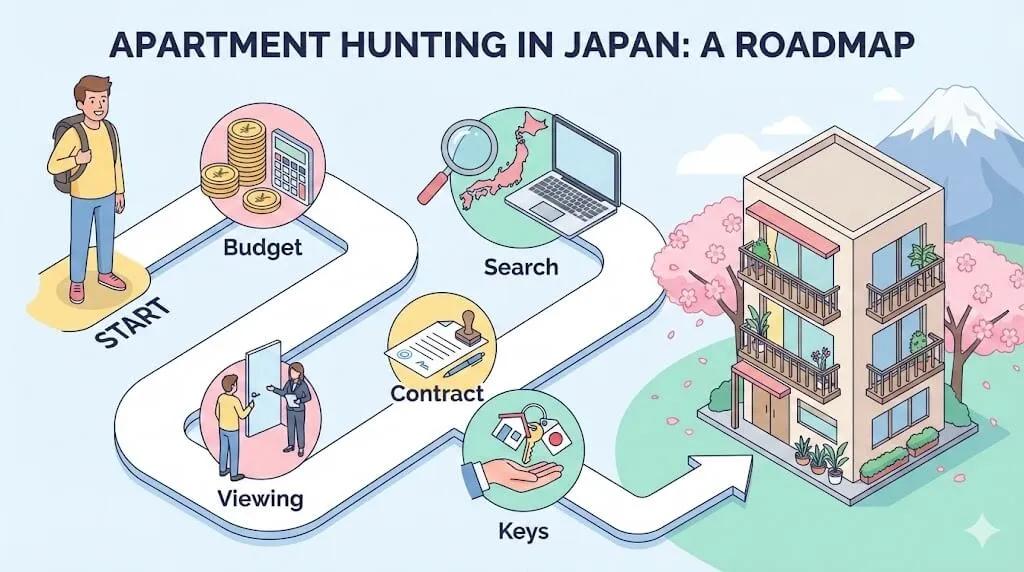
[2025 Guide] The Truth About Japanese Apartment "Initial Costs": Understanding Deposit, Key Money, and How to Negotiate

CEO / Native Japanese Expert
Updated on: November 26, 2025
Why pay "5 months' rent" upfront? We break down the hidden costs of Japanese rental contracts (Shikikin/Reikin), reveal negotiation hacks real estate agents won't tell you, and introduce "Village House" for ultra-low move-in costs.
Introduction: Why Do You Have to Pay 5x the Rent Upfront?
"I tried to rent an apartment for 150,000 yen, but they asked for 790,000 yen in initial costs. Is this a scam?"
This is a desperate cry recently posted on Reddit (r/japanlife). Unfortunately, this is not a scam. This is the "standard" practice in Japan.
The Japanese rental system is, in some ways, designed to collect a "Foreigner Tax" (a tax on ignorance) from those who don't know the rules. "Key Money (Reikin)," "Agency Fee," "Mystery Option Fees"... If you pay these as requested, you are throwing away tens of thousands—sometimes over 100,000 yen—down the drain.
However, if you know "what is mandatory and what can be refused," these costs can drop dramatically.
In this article, we reveal the "truth about initial costs" that real estate agents will never tell you, and the "negotiation tactics" to hack your estimate and rent cheaper.
What You Will Learn
- ✅ Anatomy: The breakdown of initial costs and "money you don't have to pay."
- ✅ The Trap: The hidden high penalties behind trendy "Zero-Zero Properties."
- ✅ Weapons: Magic Japanese phrases to cut "Disinfection Fees" and "Key Money."
- ✅ Solution: How to keep initial costs under 50,000 yen without negotiating.
1. Anatomy of Initial Costs: Know Your Enemy
First, let's understand the true nature of the enemy (the Estimate). When renting an apartment in Tokyo, the average initial cost is 4.5 to 5 months' worth of rent.
The Standard Breakdown
| Item | Japanese | Average Cost | Meaning & Verdict |
|---|---|---|---|
| Security Deposit | Shikikin | 1 month | Collateral. Refunded upon moving out (minus cleaning fees). |
| Key Money | Reikin | 1 month | Gratuity. A gift to the landlord. Non-refundable. |
| Agency Fee | Chukai-tesuryo | 1 month + tax | Commission. The agent's fee. Negotiable. |
| Advance Rent | Mae-yachin | 1 month | Rent for the first month paid upfront. Mandatory. |
| Guarantor Fee | Hosho-ryo | 0.5 - 1 month | Co-signer Service. Almost mandatory for foreigners. |
| Fire Insurance | Kasai-hoken | ¥20,000 | Insurance. Mandatory, but you don't have to use their provider. |
| Lock Exchange | Kagi-koukan | ¥20,000 - ¥30,000 | Security. Often mandatory. |
💡 Key Point "Shikikin" (Deposit) is your asset, but "Reikin" (Key Money) and "Agency Fees" are sunk costs. These two are your targets for saving money.
2. The 2025 Trap: The Truth About "Zero-Zero Properties"
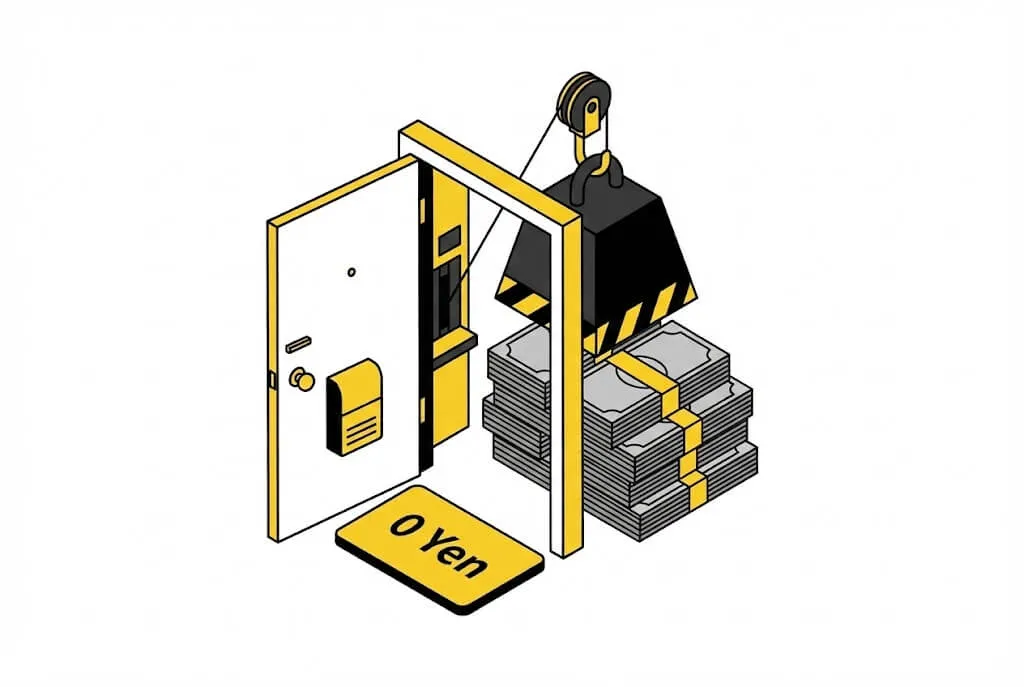
Recently, you might see "0 Deposit / 0 Key Money (Zero-Zero Bukken)" listings on Suumo. It's dangerous to jump on these just because "initial costs are cheap!" There is no such thing as a free lunch.
The Trap of Zero-Zero Properties
Real estate companies are not volunteers. They recover what they made "free" at the entrance from somewhere else.
- Upfront Cleaning Fee: Instead of paying when you leave, you are forced to pay 30,000 to 60,000 yen upfront. It's essentially a disguised "Deposit."
- Short-term Cancellation Penalty: This is the biggest trap. It often comes with a clause: "If you cancel within 1 year, you must pay 1-2 months' rent as a penalty."
- Inflated Rent: The monthly rent might be set 2,000 to 3,000 yen higher than the market rate. If you live there for 2 years, you end up paying more than the Key Money.
Conclusion: If you are absolutely sure you will live there for 2+ years, it's a good deal. But if you choose it as "temporary housing," you will lose big on penalties when you move out.
3. [Practice] Estimate Hacks & Negotiation Masterclass
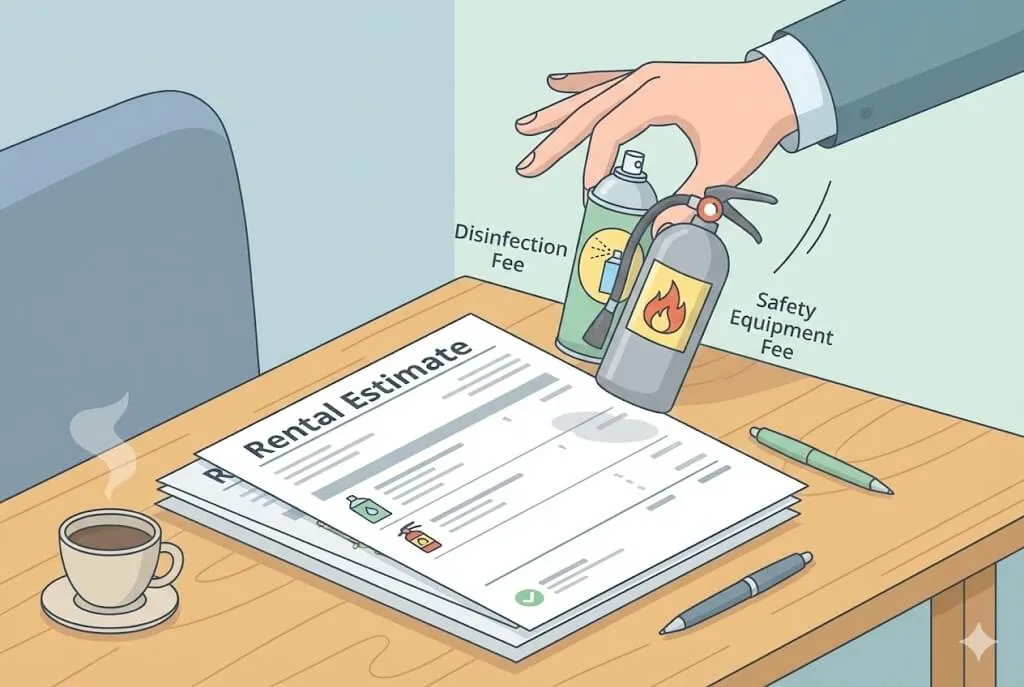
Here is the main event. When the real estate agent sends you the Estimate, check for these "rip-off items."
❌ Step 1: Remove Unnecessary Options
These are "pocket money" items for the real estate agent that you are not legally obligated to pay.
| Item | Cost | How to Refuse (Japanese Script) |
|---|---|---|
| Disinfection Fee<br>(Shoshu-Kokin) | ¥15,000 - ¥20,000 | "Is this optional? Please remove it."<br>(Kore wa nini option desu yone? Fuyo nanode hazushite kudasai.) |
| 24h Support<br>(Anshin Support) | ¥15,000 - ¥20,000 | "My fire insurance covers this, so I don't need it."<br>(Kasai hoken ni nita service ga tsuiteiru node, kochira wa fuyo desu.) |
| Fire Extinguisher<br>(Shokaki) | ¥10,000 - ¥20,000 | "I will buy one myself on Amazon."<br>(Jibun de Amazon de kau node fuyo desu.) |
✂️ Step 2: Cut the Key Money (Reikin)
Key Money is a "request" based fee. If the following conditions are met, you might be able to negotiate it down to zero.
- Targets: Off-peak season (April-August), older buildings, properties that have been vacant for a while.
The Ultimate Negotiation Phrase:
"If you can waive the Key Money, I will apply immediately today." (Moshi Reikin wo zero ni shite itadakeru nara, kyo sugu ni moshikomi wo shite, shinsa ni susumitai desu.)
For a landlord, a "guaranteed tenant" is worth more than 1 month of Key Money. The trick is to say "I will sign (Commitment)" rather than "I will consider it."
✂️ Step 3: Choose Your Own Fire Insurance
The insurance specified by the agent (20,000 yen/2 years) is overpriced. Online insurance like "Rakuten Sonpo" costs only about 4,000 yen per year.
Negotiation Phrase:
"Can I choose my own cheaper insurance and submit the policy certificate before move-in?" (Jibun de yasui hoken ni haitte, kagi no uketori made ni shoken no copy wo teishutsu shitemo ii desu ka?)
4. Guarantor Companies: A "Mandatory Cost" for Foreigners
Unfortunately, even if you have a Japanese co-signer, most foreigners are required to join a "Guarantor Company."
- Market Rate for Foreigners:
- Initial Fee: 50% to 100% of Rent
- Renewal Fee: ¥10,000 / year
Advice: If you have to pay a high fee anyway, choose a property that uses GTN (Global Trust Networks). GTN comes with multilingual life support (translation of garbage rules, trouble consultation), so the cost is actually worth it for the peace of mind.
5. Regional Differences: The "Shikibiki" Rule in Kansai
If you are looking for a room in Osaka, Kyoto, or Kobe, the rules are completely different.
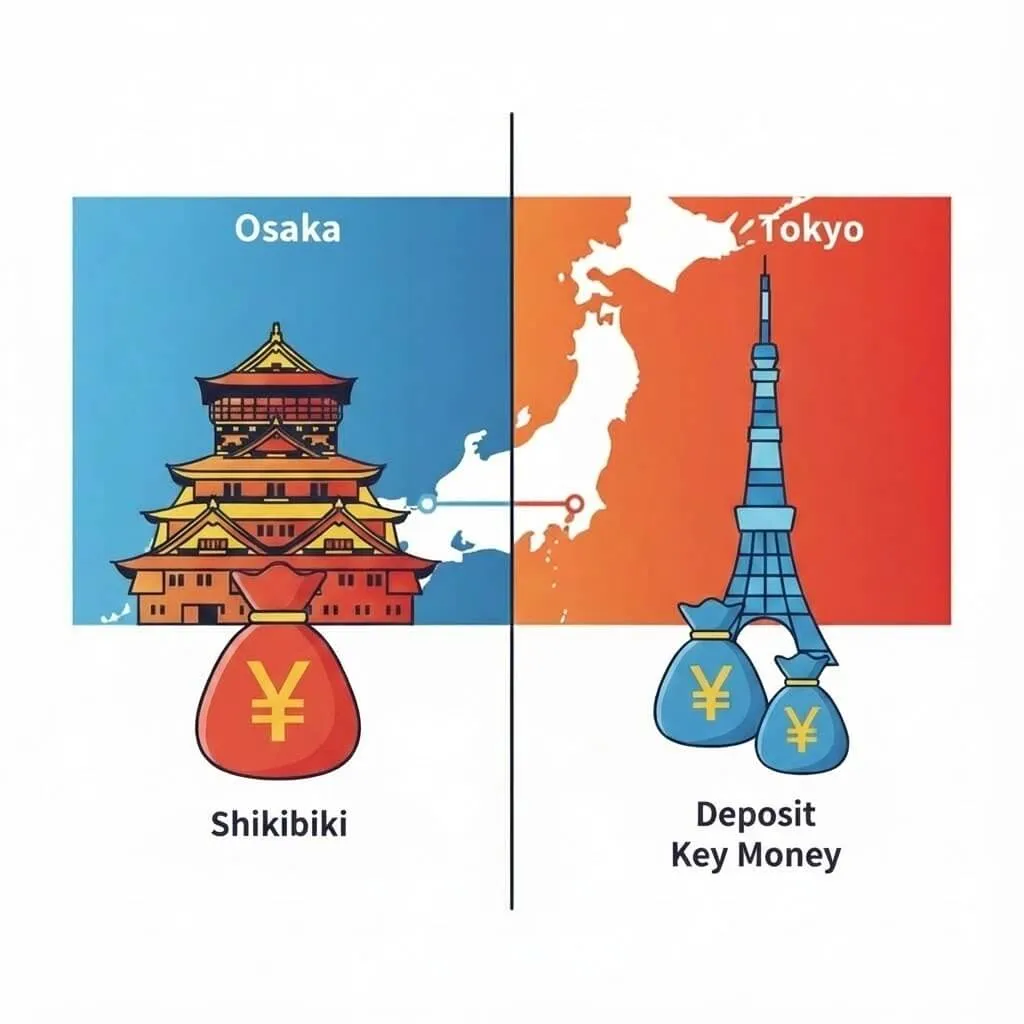
- Kanto (Tokyo): Deposit (Shikikin) + Key Money (Reikin)
- Kansai (Osaka): Deposit (Hoshokin) + Deduction (Shikibiki)
⚠️ Warning: If a Kansai contract says "Deposit 300,000 yen, Shikibiki 200,000 yen," it means "200,000 yen will absolutely not be returned (it's effectively Key Money)." Do not be fooled by the English translation "Deposit." Always check the "Shikibiki" amount.
6. The Final Solution: For Those Who Hate Negotiating
"Negotiating in Japanese is impossible!" "I'm scared of being scammed!" If that's you, choose a property with "No Hidden Costs" from the start.
✅ Village House
If you "don't mind an older building and just want the cheapest move-in cost," Village House is the strongest option.
- Key Money / Agency Fee / Renewal Fee: All ¥0
- Guarantor: Not Required
- Screening: Very flexible (Foreigner-friendly)
While a standard apartment costs 300,000 yen upfront, Village House often costs less than 50,000 yen. You can use the saved money to buy furniture and appliances.
👉 Check Village House Vacancies (Official Site)
Summary: Knowledge is Cash
The estimate presented by the real estate agent is not "absolute." It is the "starting point for negotiation."
- Get the Estimate: Always ask for a detailed breakdown.
- Cut Options: Ask "Is this optional?" and save tens of thousands of yen.
- Negotiate Key Money: Use "Immediate Decision" as your weapon.
- Use Smart Tools: Use the tools below to save unnecessary costs and hassle.
🔗 Essential Tools for Smart Foreigners
- Village House: 0 Deposit, 0 Key Money, 0 Agency Fee. The cheapest way to rent an apartment in Japan.
- Mobal SIM: A "Japanese Phone Number" is mandatory for rental contracts. Mobal allows you to get a number immediately upon arrival, without a Residence Card or Bank Account.
- Wise: If you need to transfer money from abroad for initial costs, banks will charge you hidden fees. Wise is up to 8x cheaper.
Arm yourself with this knowledge and start your new life in Japan smartly!
Need help with life in Japan?
Visa, housing, work, money... Our experts are here to support you.
Check Support ServicesDisclaimer
※ The information in this article is accurate as of the time of writing. Laws and regulations may change, so please always check official sources for the latest information. We assume no liability for any damages resulting from the content of this article.
Related Articles

[The 2026 Problem] No Visa Renewal if Pension is Unpaid? Stricter Immigration Rules Under the New Takaichi Administration & Tax Steps Foreigners Must Take Now

[2025 Picks] Top 5 Rental Services for Foreigners in Japan: Compared by English Support & Approval Rates